May, 2026
Did you know that May is Skin Cancer Awareness Month? Up until a few days ago I had no clue. But now for me, this is one of the most important months of the year. It’s important to me because I have been dealing with skin cancer for the last few months. But also because I truly see the importance of raising awareness so that you know how to help prevent future skin cancer, what symptoms to look for if you are concerned you or someone you know may have skin cancer as well as what are the next steps should you get diagnosed. Something that was also one of my main aims when I created my series of blogs a while back.
Firstly let’s talk about prevention. There are certainly a few simple precautions that you can take that can help prevent skin cancer.
•Wear UV protected clothing
Clothing helps to keep the sun away from your skin. You may see clothing with UV protection mentioned. This type of clothing is designed to protect your skin from harmful UV (ultraviolet) radiation. They are made with specialist fabrics with high UPF (Ultraviolet Protection Factor) to block UVA (ultraviolet aging) and UVB (ultraviolet burning) rays without needing to apply sunscreen. If you are looking at UV protected clothing, look for the UV rating. It is recommended to wear UV protected clothing with a rating of 30 or higher. Clothing with a UPF rating of 50+ blocks approx 98% of UV rays. Ideally choose long sleeved t-shirts, as well as long sleeved trousers/skirts as the more skin that is covered, the more protection you are offered. Don’t forget to keep your head and eyes protected as well by wearing UV protected hat and sunglasses.
It’s also important to mention that the colour of the clothing can help. Darker and brighter coloured clothing absorb UV rays, rather than allowing the rays to penetrate your skin.
•Wear sun tan lotion
If you cannot wear long clothing, ensure you wear sun tan lotion. Look for sun tan lotions with a 4 or 5 star UVA rating, and a SPF (Sun Protection factor) rating of 30 or higher. Also ensure that the label states ‘broad spectrum’ to protect against UVA and UVB rays.
When applying sunscreen, be generous with the amount applied. Apply around 2 fingers worth for your face and neck, and apply enough sunscreen to fill a shot glass/6-8 teaspoons when applying to your body – don’t forget your ears and feet etc as well. It is recommended to apply the lotion around 30 minutes before going out into the sun and be mindful that sunscreen can rub off. So ensure you are continually covered and re-apply every 2 hours, or immediately after swimming/if you are sweating.
•Avoid artificial UV (sunbeds)
The World Health Organisation has classed sunbeds as a Group 1 Carcinogen, the same category as Tobacco. Likewise the UK government are introducing stricter regulations on commercial sunbeds due to melanoma risks. There is a 75% risk of developing a melanoma if you use tanning beds before the age of 35.
Sunbeds use high intensity UV rays radiation, the same as the sun. You may see claims that sunbeds are a safer way to get a tan compared to sunbathing, this is incorrect!
Skin cancer risk factors
It’s also important to take a moment to talk about some potential skin cancer risk factors.
•Skin Type (Fair Skin): Individuals with skin that burns, freckles, or turns red easily in the sun are most at risk. This includes people with light-coloured hair (blonde or red) and blue or green eyes.
•Sunburn History: A history of blistering sunburns, particularly during childhood or adolescence, significantly increases risk.
•UV Exposure: High, cumulative exposure to UV radiation from the sun and/or sunbeds.
•Mole Count: Individuals with a high number of moles (more than 50) or atypical (dysplastic) moles are more susceptible to melanoma.
•Family/Personal History: A personal or family history of skin cancer (especially melanoma).
•Older Age: Risk increases with age, as skin damage accumulates over time.
•Weakened Immune System: Individuals with immune suppression, such as transplant recipients, have a higher risk.
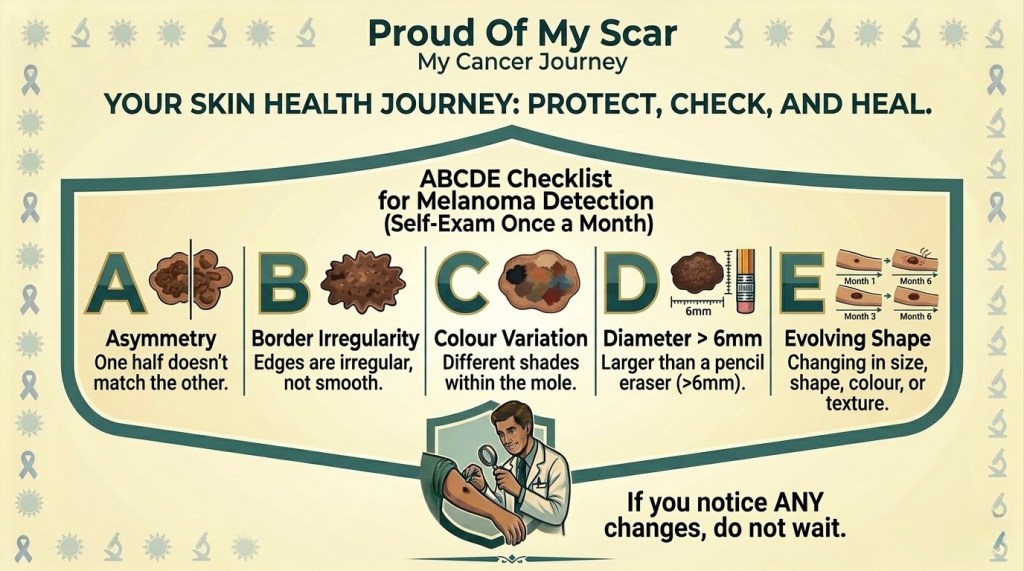
If you feel that any of the above is applicable to you, do ensure you use the preventative measures mentioned above when going out into the sun. And of course if you do spot any new, changing, or unusual growths, spots, or bumps on the skin that persist, bleed, itch, or do not heal within four weeks seek medical assistance ASAP. Key warning signs are pearly/waxy bumps (basal cell), firm red nodules (squamous cell), or changing moles (melanoma).
A big thank you to the Skin Cancer Foundation for the use of 2 their images in today’s blog. Read more about the Skin Cancer Foundation and a lot of useful information at: https://www.skincancer.org


Leave a Reply